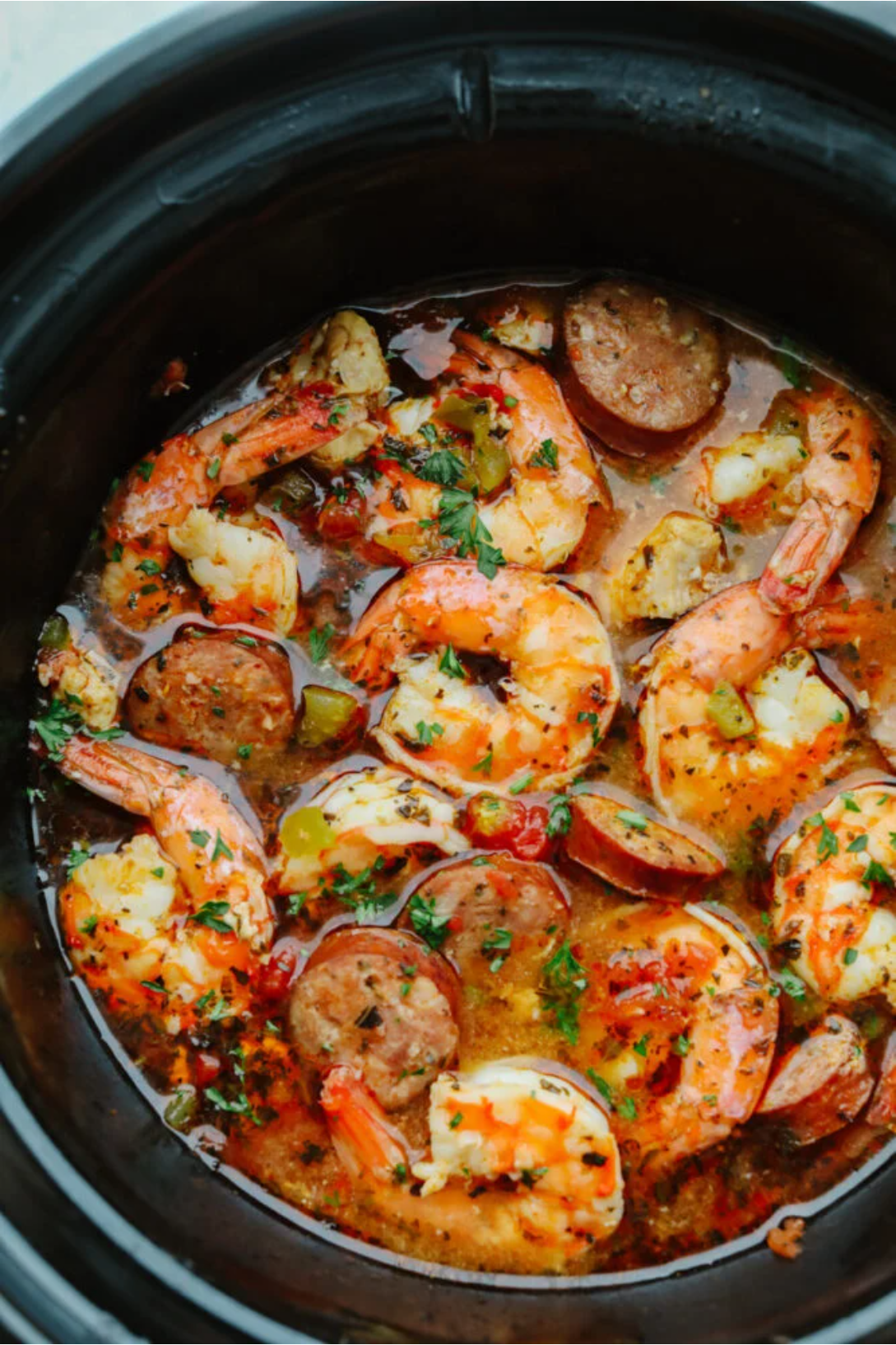
Some foods are products of the land. Not the fancy, packaged ingredients you carefully select in a high-end supermarket, but the things that grow from the soil, are scooped from the river, and hang in the smokehouse. Jambalaya is such a food. It comes from the Louisiana marshes, from the descendants of French immigrants, from the descendants of African slaves, from the legacy of Spanish colonists. It is a cultural hybrid, a distillation of history, a medley simmered for three hundred years.
The first time I made this dish, it was snowing outside. Not the light, feathery kind of snow, but the heavy, damp, cold kind that makes you want to wrap yourself in a blanket. I was in the kitchen cutting sausages, listening to the slow cooker bubbling away, and suddenly felt a connection to some damp, jazz-filled, carnival-like place I’d never been before. That’s the power of food—it can make you feel the warmth of another world from a thousand miles away. —
About Andouille: The Smoked Soul
Andouille is the soul of this dish. Not the pink, mushy kind you get at a hot dog stand, but a coarse-grained, dark brown Louisiana specialty with a strong smoky flavor. It’s made from pork, coarsely ground, seasoned, stuffed, and then cold-smoked for a long time until the outer skin turns a deep brown and the inside is filled with an undeniable, slightly spicy, smoky aroma reminiscent of campfires and pine.
When Andouille is sautéed in a skillet, it releases a lot of oil. This isn’t ordinary lard, but a concentrated essence of flavor, infused with spices and smoke. What you do is: slice the sausage into quarter-inch thick rounds, place them in a hot pan over medium heat, without oil, and let the sausage’s own oil slowly render out. Five to seven minutes, stirring occasionally, until the edges of the slices begin to curl, caramel-colored spots appear on the surface, and the kitchen fills with that mouthwatering smoky aroma.
At this point, a layer of brown, caramelized residue—called a “fond” in French, meaning “bottom”—will remain in the pan. Don’t wash it off. That’s the most precious part of the dish. Pour a little dry white wine—about a quarter cup—into the pan and scrape up the brown residue with a spatula, letting it dissolve in the wine. This process is called “deglaze,” a fundamental technique in French cooking. The wine will release all the flavors clinging to the bottom of the pan, turning it into a concentrated, glossy liquid. Then, pour this mixture of wine and residue into the slow cooker. Now, your slow cooker contains the essence of the dish.
If you can’t find Andouye sausage, you can substitute other smoked sausages—Polish sausage, Spanish chorizo, or even Sichuan sausage from China. But the results will be less impressive. The smoky flavor of the Anduye sausage is unique and irreplaceable; it’s the signature of Louisiana, the dish’s identity. Without it, the dish is still delicious, but it’s no longer jambalaya—it’s just another sausage risotto.
Holy Trinity: A Vegetable Prayer
There’s a concept in Louisiana cuisine called “the holy trinity”—onions, green peppers, and celery. Not carrots as in French mirepoix, but green peppers. This substitution has a reason: Louisiana’s climate isn’t suitable for growing carrots, but green peppers thrive. So, when French immigrants arrived in New Orleans, they replaced the carrots in mirepoix with green peppers, creating their own tropical vegetable combination.
One medium-sized onion, one green pepper, and two celery stalks, all coarsely chopped. Not the delicate kind that requires fine dicing—jambalaya isn’t a refined dish; it’s rugged, passionate, and a little chaotic. The coarse chunks soften slowly during simmering, releasing their sugars and aromas, eventually almost melting into the broth, leaving only flavor, not shape.
Onions provide depth and sweetness. Green bell peppers offer a refreshing, slightly bitter, invigorating green aroma. Celery provides a unique, slightly salty, earthy, and vegetal scent. Together, they form a complex yet harmonious base—something no single vegetable can provide alone. This is the power of the Trinity: one plus one plus one equals more than three.
Four cloves of garlic, chopped, are added to the pot with the Trinity. Garlic isn’t the main ingredient here, but it’s the indescribable element that makes the other flavors more complete. Without garlic, the soup lacks a base umami, a supporting force that allows the flavors to “stand up.” As the garlic and Trinity simmer in hot oil, an undeniable, warm, and slightly spicy aroma fills the kitchen. At this point, your kitchen is starting to have a New Orleans vibe.
Chicken: Tender Bones
The chicken used is boneless chicken breast, cut into one-inch cubes. Not chicken thighs—although thighs are more resistant to overcooking and juicier, in this dish that requires slow cooking for several hours, the breast will retain its shape, while the thighs will become too mushy and fall apart. The chicken breast, heated slowly and for a long time in the slow cooker, becomes tender and juicy, the fibers loosening while still maintaining its shape, ensuring you get real chicken in every bite.
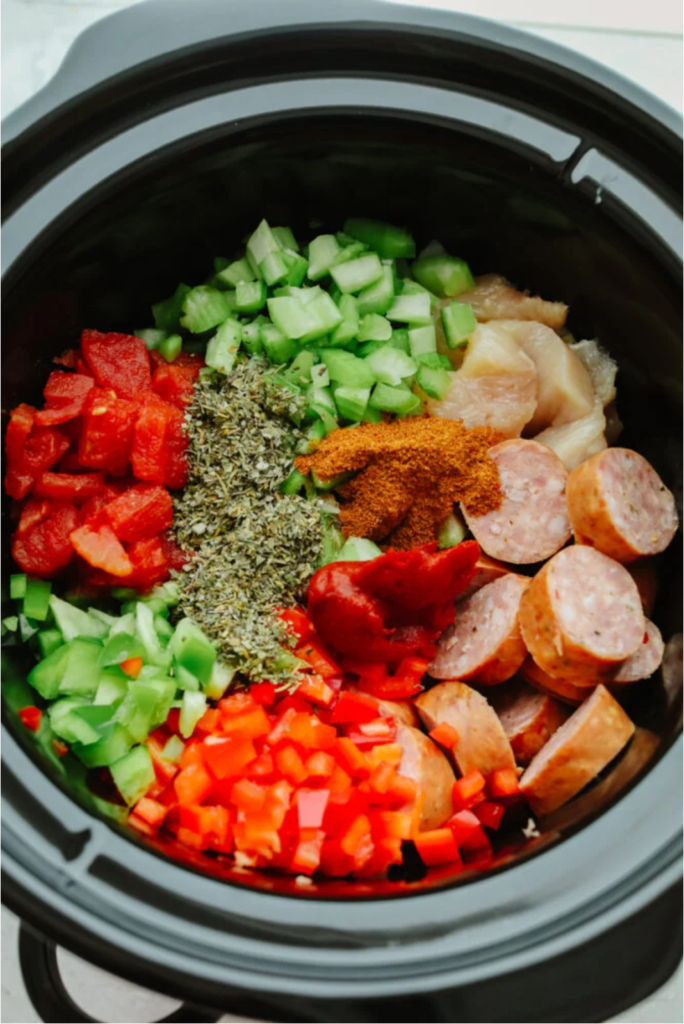
Sauté the chicken cubes with the sausage, Trinity, and garlic for a minute or two to coat them with oil and lock in the juices. Then pour everything into the slow cooker. Now the slow cooker contains: seared Anduye sausage, fondant wine, sautéed Trinity and garlic, and chicken cubes. They are layered together, like an unfinished oil painting, awaiting the final touches. —
Tomatoes and Broth: A Liquid Canvas
Tomatoes are the turning point in this dish. A 28-ounce can of crushed tomatoes—not diced, but crushed. Crushed tomatoes are thicker, smoother, and blend more easily with the rice than diced tomatoes. Its color is a deep red with a hint of orange, like the color of a sunset. Pour it into the slow cooker and stir it with everything else. You’ll see the liquid transform from clear to cloudy, from colorless to deep red, from bland to rich.
Two cups of chicken broth—not the watery, pale yellow liquid poured from a container, but a rich, dark-colored broth with a chicken fat aroma. The broth’s role here is to provide the liquid’s framework, giving the rice something to absorb as it cooks. If the broth is too weak, the rice will absorb the flavor, but only the taste of water; if the broth is strong enough, the rice will absorb the richness and umami of the broth.
Dry white wine is optional, but I recommend not omitting it. A quarter glass, plus about half a glass when combined with the wine used for the deglaze while frying the sausages. The wine’s acidity will brighten the dish, adding complexity and a touch of unexpected twist. It’s not as sharp as vinegar, nor as crisp as lemon, but a rounded, fruity flavor reminiscent of vineyards and sunshine. If you don’t drink wine, you can substitute more chicken broth, but the effect will be less pronounced—lacking that characteristic, life-giving acidity of the wine.
Spices: The Heartbeat of Creole
Spices are the soul of this dish. Not a single, assertive spice, but a complex, multi-layered aroma reminiscent of the Caribbean and the Mediterranean.
Three to four tablespoons of Creole seasoning. Creole seasoning is typically a blend of salt, onion powder, garlic powder, chili powder, paprika, black pepper, white pepper, thyme, oregano, and other spices, resulting in a mild yet complex flavor with a hint of smokiness and a touch of citrus freshness. Each brand’s recipe is slightly different—Tony Chachere’s is spicier, Zatarin’s is milder—you can choose according to your own taste. Add more if you like it spicier; add less if you prefer it milder. The beauty of Creole seasoning is that it’s “one-stop shop”—you don’t need to mix a dozen spices yourself; it does all the work for you.
One teaspoon of red pepper flakes is optional. It provides a direct, unmasked spiciness—not the mild, complex spiciness of Creole seasoning, but a tingling, thirst-quenching spiciness. Omit it if you can’t handle spice; add more if you like it spicy. It’s your choice, your signature.
Two sprigs of fresh thyme, or half a teaspoon of dried thyme. Thyme has a woody, slightly lemony flavor reminiscent of sun-drenched Mediterranean hillsides. It’s not an overpowering herb, but rather an element that works quietly in the background, making the whole flavor more complete. Fresh thyme is better than dried—its aroma is fresher, brighter, and more vibrant. But if you only have dried, that’s perfectly fine too.
Two bay leaves. Bay leaves have a subtle, slightly bitter flavor reminiscent of forests and autumn leaves. They slowly release their aroma during simmering, blending with the other spices to create a deeper, more complex whole. Remember to remove and discard the bay leaves after cooking—they’ve done their job and don’t need to be left in the bowl.
Salt and black pepper, to taste. The amount of seasoning depends on how salty your Creole seasoning is, how rich your chicken broth is, and how strong your flavor is. Don’t add too much at once—you can taste as you add, but it’s difficult to remove excess salt. Be conservative, take your time, until that sip of soup makes you feel, “This is it.”
Rice: The Magic from Liquid to Solid
The rice is the final and most crucial ingredient in this dish. It’s not added at the beginning, but after slow cooking for three and a half hours—after the chicken is tender, the sausage has released all its flavor, and the tomatoes and other ingredients have fully melded.
One and a half cups of long-grain white rice. Not short-grain, not brown, not basmati—long-grain white rice is ideal because it cooks into distinct grains, doesn’t clump together, and absorbs the broth’s flavor beautifully. Add the rice to the slow cooker, stir well, making sure every grain is covered in the liquid. Then cover and cook for another thirty minutes.
These thirty minutes are when the magic happens. The rice grains slowly expand in the hot broth, transforming from hard pebbles into soft, plump grains infused with the broth’s color. They absorb not only water, but also the sweet and sour flavors of tomatoes, the smokiness of sausage, the complexity of spices, and the richness of chicken broth. Each grain of rice becomes a tiny flavor capsule; when you bite into it, the juices burst forth, mixing with your saliva to create a blissful sensation that makes you close your eyes.
After thirty minutes, open the lid and gently separate the rice with a fork. Do not stir—stirring will break the grains and turn them into a paste. Separating means using a fork to gently lift the rice from the bottom, separating each grain to release steam and prevent them from sticking together. At this point, the rice should be: distinct grains, moist, but not soaked in broth; each grain should be fully infused with flavor, yet retain its shape and texture.
Shrimp: The Final Surprise
The shrimp is added in the last fifteen minutes. Not at the beginning—overcooking shrimp makes it rubbery and loses its bouncy, delightful texture. Add one pound of shelled and deveined shrimp to the slow cooker fifteen minutes after the rice has cooked—fifteen minutes before it’s done. Stir well, cover, and continue cooking.
The shrimp will quickly change color in the hot broth, from a grayish-white translucent to a pinkish-opacity. After fifteen minutes, they should be: curled, pink, springy to the touch, and with a subtle sea flavor. Don’t overcook—overcooked shrimp is one of the biggest tragedies in the kitchen; it only takes five minutes for them to go from delicious to disastrous.
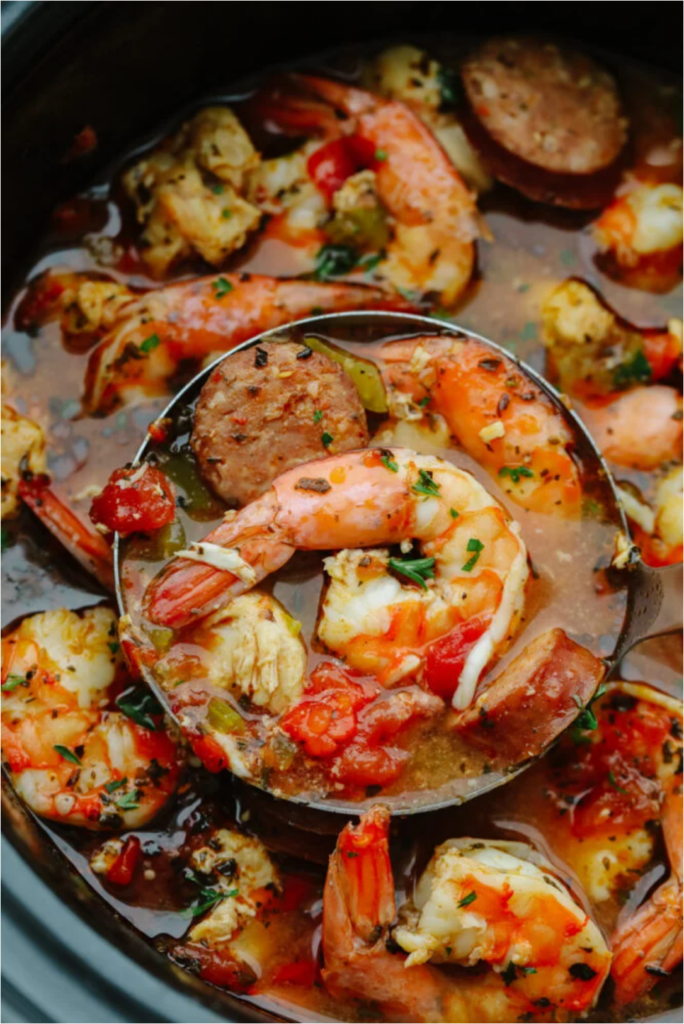
The shrimp here serves more than just protein. They provide a fresh, slightly sweet, oceanic flavor that balances the smokiness of the sausage and the richness of the spices. And the shrimp’s color—pink—stands out like tiny jewels between the deep red tomatoes and golden rice, making the whole dish look more appealing and layered.
Assembly and Garnishing: The Final Touches
Gently loosen everything in the slow cooker, lifting from the bottom with a fork to distribute the rice, chicken, sausage, and shrimp evenly. Don’t stir vigorously—you’ll break the rice. Be gentle, like you’re handling a sleeping child.
Then taste it. Add salt, black pepper, until you feel it’s perfect. If you like it spicier, add a spoonful of hot sauce—Tabasco is a classic choice, Louisiana Hot Sauce is also good. Hot sauce isn’t necessary, but it’s an option—the freedom to adjust it to your liking.
Pour it into bowls. Not shallow soup bowls, but deep ones you can hold in your hands. The colors should be vibrant: deep red tomatoes, golden rice, pink shrimp, brown sausage, and green cilantro. It should be messy, colorful, unapologetic—like Louisiana itself.
Sprinkle with chopped cilantro and chives. The freshness of the cilantro contrasts with the overall richness of the dish; its green contrasts with the deep red tomatoes; its crispness contrasts with the softness of the rice. Chives provide the spiciness of onions and a touch of crunch. They are not garnishes, but essential—without them, the whole bowl would be too heavy, too rich, too suffocating.
How to Eat
Use a fork. Starting from the rim of the bowl, fork up a little rice, a piece of chicken, a slice of sausage, a shrimp. Make sure every bite has all the elements—rice, meat, shrimp, and vegetables. Put it in your mouth, first feeling the tenderness of the shrimp with your teeth—that satisfying bite that requires a little effort. Then comes the smoky flavor and complex spices of the sausage, spreading from the tip of your tongue throughout your mouth. Next comes the soft, sticky rice, soaking up all the flavors, melting on your tongue. Finally, the freshness of the cilantro rises from your nasal cavity, clearing away all the rich flavors and preparing you for the next bite.
The last few bites are usually the best. The bottom of the bowl holds the essence of all the flavors—tomato juice, chicken fat, sausage oil, spices, and the starch of the rice. Scrape them up with a fork—it’s a concentrated, unreserved, and blindingly delicious experience. You’ll want to lick the bowl clean, but restrain yourself—save a little for the next meal.
Some Random Thoughts
The most fascinating aspect of this dish is its cultural fusion. French immigrants brought mirepoix and cooking techniques, Spanish colonists brought rice and tomatoes, African slaves brought spices and culinary wisdom, and Native Americans brought their native ingredients and knowledge. They mingled together, fermenting, blending, and evolving in the Louisiana swamps, ultimately becoming this messy, colorful, unapologetic dish. This is the essence of jambalaya: not delicate, but rich; not singular, but harmonious; not quiet, but vibrant.
Regarding Anduye sausage, I know some may find it hard to find. But if you live in North America, most supermarkets have it in their sausage section—usually next to the smoked sausages. If you can’t find it, you can substitute Polish smoked sausage or Spanish chorizo, but the effect won’t be as good. The smoky flavor of Anduye sausage is unique and irreplaceable; it’s the dish’s identity card.
Regarding Creole seasoning, each brand has a different recipe and level of spiciness. I recommend buying small samples to try first to find a brand that suits your taste. Tony Chachere’s is the most common, but also one of the spiciest. If you can’t handle spice well, use Zatarain’s or make your own—a mixture of salt, onion powder, garlic powder, paprika, black pepper, thyme, and oregano, in proportion.
Regarding the rice, it’s crucial to add it in the last 30 minutes. Adding it at the beginning will result in overcooked, mushy rice. Jambalaya isn’t porridge; it’s rice—grain-by-grain, chewy, and flavorful. Timing is key: cook the chicken and sausage first to release their flavors; then add the rice to absorb the flavors; finally, add the shrimp to keep them tender and juicy.
Regarding leftovers: This dish is still delicious the next day, with the flavors even more harmonious. However, the rice will continue to absorb the broth, becoming drier. To restore its original texture, add a spoonful of chicken broth or water while reheating and stir well. It can be refrigerated for three to four days and frozen for up to a month. When freezing, divide into small portions and thaw and reheat before eating.
I make this dish during Carnival. Not because it’s exclusively for Carnival—it can be made year-round—but because the spirit of Carnival is the same as the spirit of this dish: lively, abundant, unpretentious, and joyful. It’s perfect for parties, family meals, any occasion where you need to feed a group. It’s messy, colorful, unapologetic—like carnival itself.
When you sit at the table with your bowl, fork dangling from crimson rice, pink shrimp, and brown sausage, and snow may be falling outside, you’ll remember that afternoon you decided to make a pot of Louisiana risotto. Back then, you thought it was just ordinary risotto. Now you know it’s something better—it’s a cultural experience, a condensation of history, the simplest and most profound magic in the kitchen.
And it’s really delicious. So delicious that you’ll want to make it again and again. So delicious that on a cold afternoon, you’ll suddenly remember its taste, walk into the kitchen, and start chopping sausages.
Preparation Time: Approx. 20 minutes
Cooking Time: Approx. 4-5 hours (slow cooker, high setting)
Total Time: Approx. 4.5-5.5 hours
Servings: 6-8 people
Difficulty: Can be made with any slow cooker
What You’ll Need:
Meat & Seafood:
- 12 oz (approx. 340g, cut into 1/4-inch round slices)
- 2 boneless chicken breasts (approx. 450g, cut into 1-inch cubes)
- 1 lb (approx. 450g, shelled and deveined)
Trinity Vegetables:
- 1 medium onion (roughly chopped)
- 1 green bell pepper (roughly chopped)
- 2 celery stalks (roughly chopped)
- 4 cloves garlic (minced)
Liquid & Tomatoes:
- Crushed tomatoes Ingredients:
1 can (28 oz/approx. 800g) of tomatoes
2 cups of chicken broth
1/4 cup + 1/4 cup (optional, for slow cooker) of dry white wine
Spices and Seasonings:
3-4 tablespoons of Creole seasoning
1 teaspoon (optional) of red pepper flakes
2 sprigs of fresh thyme (or 1/2 teaspoon of dried thyme)
2 bay leaves
Salt to taste
Black pepper to taste
Rice:
1.5 cups of long-grain white rice
Garnish:
Fresh cilantro (chopped)
Chives (chopped)
Tabasco or Louisiana Hot Sauce (optional)
Instructions:
- **1. *Fry the Sausage:* Heat a skillet over medium heat without oil. Add the round slices of Andouye sausage and fry for 5-7 minutes, until golden brown and the sausage is rendered. Remove the sausage, reserving the oil and brown fond in the skillet.
- ** Deglaze: Pour in 1/4 cup dry white wine and scrape up the brown fond from the bottom of the skillet with a spatula to dissolve it into a concentrated liquid. Transfer the sausage and wine mixture to the slow cooker.
- ** Sauté the Vegetables and Chicken: In the same skillet, combine the Trinity vegetables (onion, bell pepper, celery) and minced garlic. Sauté for 3-5 minutes until the onion is translucent. Add the chicken pieces and sauté for 1-2 minutes until lightly browned. Transfer everything to the slow cooker.
- ** Add Liquid and Spices: Add the crushed tomatoes, chicken broth, remaining wine (if using), Creole seasoning, chopped red pepper, thyme, and bay leaf. Stir well and adjust seasoning with salt and pepper.
- ** Slow Cook: Cover and cook on high for 3.5-4 hours. 6. Add Rice: After 3.5 hours, open the lid, add long-grain white rice, and stir well to ensure the rice is covered by the liquid. Cover and continue cooking for 30 minutes, or until the rice is fully cooked.
- Add Shrimp: After the rice has cooked for 15 minutes (15 minutes before the end of cooking), add the shrimp, stir well, cover, and continue cooking for 15 minutes, or until the shrimp turn pink and opaque.
- Assemble: Remove the bay leaves and thyme sprigs. Gently break up the rice with a fork. Serve in a deep bowl, sprinkle with cilantro and chopped chives. Add hot sauce to taste.
- Pick up your bowl, find a lively spot, and enjoy your meal. Don’t rush; this dish is worth the time to savor.
Tips:
- Andouye sausage is irreplaceable. If unavailable, Polish smoked sausage or Spanish chorizo can be used, but the flavor will be less pronounced.
- The rice must be added in the last 30 minutes; adding it too early will cause it to become mushy.
- Add the shrimp in the last 15 minutes; adding them too early will make them rubbery.
- Leftovers can be refrigerated for 3-4 days or frozen for up to 1 month. Add a spoonful of chicken broth or water when reheating to restore moisture.
- For a richer flavor, use bacon fat instead of regular oil before frying the sausages.