
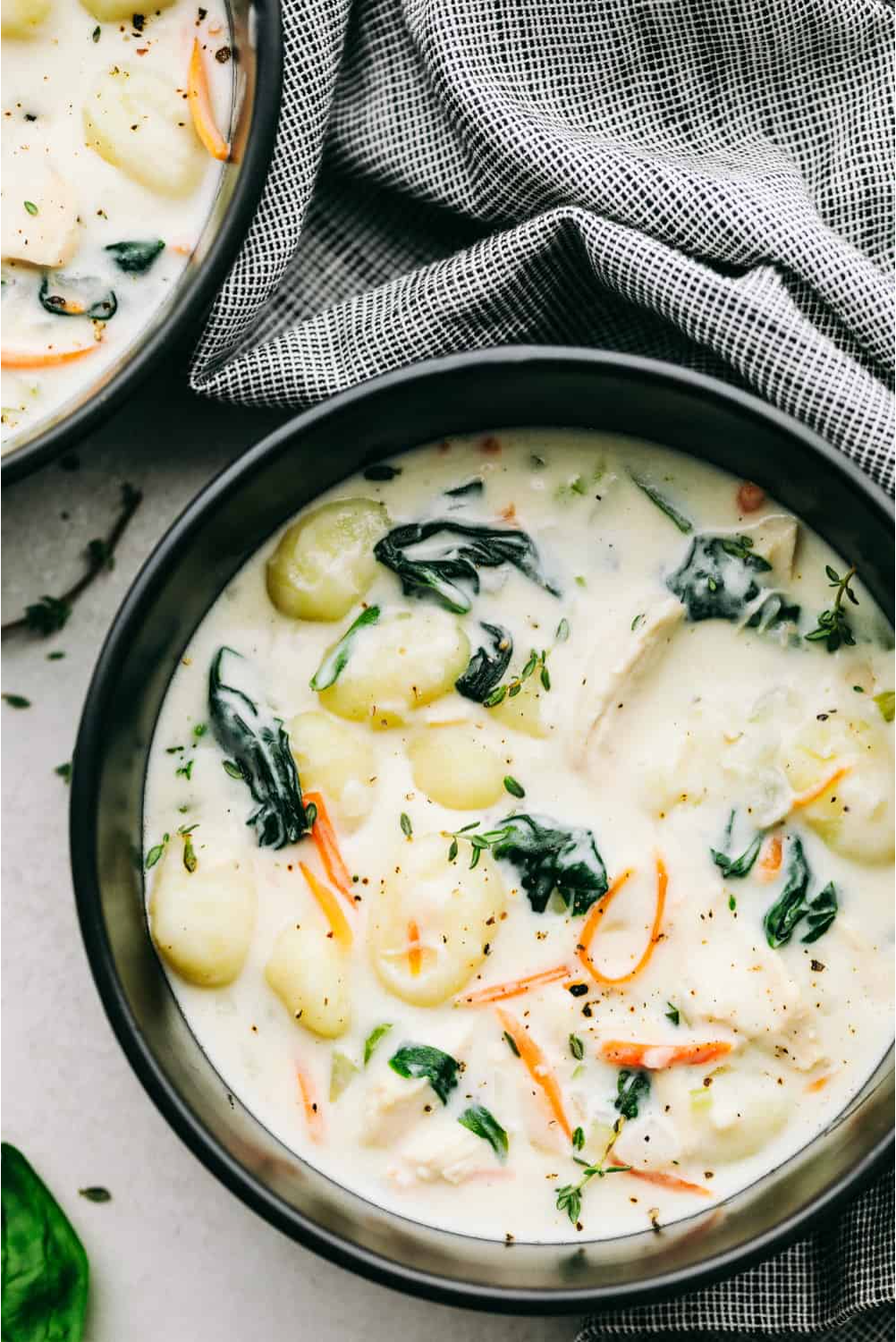
Some foods are containers of memories. They don’t just feed you, but at a specific moment, they bring back a piece of the past. This creamy chicken gnocchi soup is like that—it reminds me of a winter afternoon, raining outside, sitting in a corner of a chain Italian restaurant, a steaming bowl of soup in front of me. The soup was milky white, with a few dark green leaves floating on the surface, and tiny white gnocchi balls hidden in the cream, like pearls. I scooped up a spoonful and put it in my mouth; at that moment, the world went quiet.
Later I learned that the soup was called chicken gnocchi soup. Gnocchi, in Italian, means “lumps” or “dumplings”—small dough balls made from potatoes, flour, and eggs, which become fluffy and soft like pillows after cooking. They are not noodles, not dumplings, not glutinous rice balls, but something in between, something with its own temperament. In the creamy soup, they absorb all the flavors, becoming plump, moist, and bursting with juice with every bite.
This dish doesn’t require you to fly to Italy or step into a chain restaurant. All you need is a pot, a few common ingredients, and about forty minutes. Then, your kitchen will be filled with that irresistible, warm, slightly milky aroma.
About Gnocchi: The Potato’s Second Life
Gnocchi is the soul of this dish. Not the kind of instant gnocchi you grab from the supermarket and toss into boiling water—though that works too—but the kind of historical food you’ll respect once you understand its essence. The history of gnocchi dates back to ancient Rome, when people made small dough balls from flour and water and ate them in soup. Later, potatoes spread from the Americas to Europe, and Italians discovered that mixing potatoes and flour created a fluffier, softer dough. Thus, potato gnocchi was born.
Supermarket gnocchi usually come in three types: fresh, frozen, and vacuum-packed. Fresh is best—it has the fluffiest, softest, and most vibrant texture. However, fresh gnocchi don’t keep well and aren’t available in every supermarket. Frozen gnocchi are also acceptable, but you need to be careful when cooking them, otherwise they’ll become overcooked. Vacuum-packed gnocchi are the most common—they can be stored at room temperature for several months. When opened, the dough is dry and slightly firm, but after being cooked in the broth, it absorbs the flavors and becomes soft, plump, and just like freshly made.
One pound of gnocchi is about sixteen ounces. Don’t add it all at once—adjust the amount according to the amount of broth. If there’s too much broth, the gnocchi will sink to the bottom and won’t absorb enough flavor; if there’s too little broth, the gnocchi will clump together and become a mushy mess. The ideal ratio is: the broth should completely cover the gnocchi, but there should be enough space between them for them to float, roll, and bump into each other.
The gnocchi should be cooked for a short time—three to five minutes. Unlike pasta, which needs to be cooked for eight to ten minutes, the texture of gnocchi dictates that it doesn’t need that long. It’s done when it starts to float to the surface of the soup. At this point, the gnocchi should be fluffy, soft, springy to the touch, and retain a slight potatoy texture in the center. If overcooked, it will become mushy, lose its shape, and turn into a lump of starch. This is the biggest tragedy of gnocchi—it only takes two minutes for it to go from a pillow to porridge.
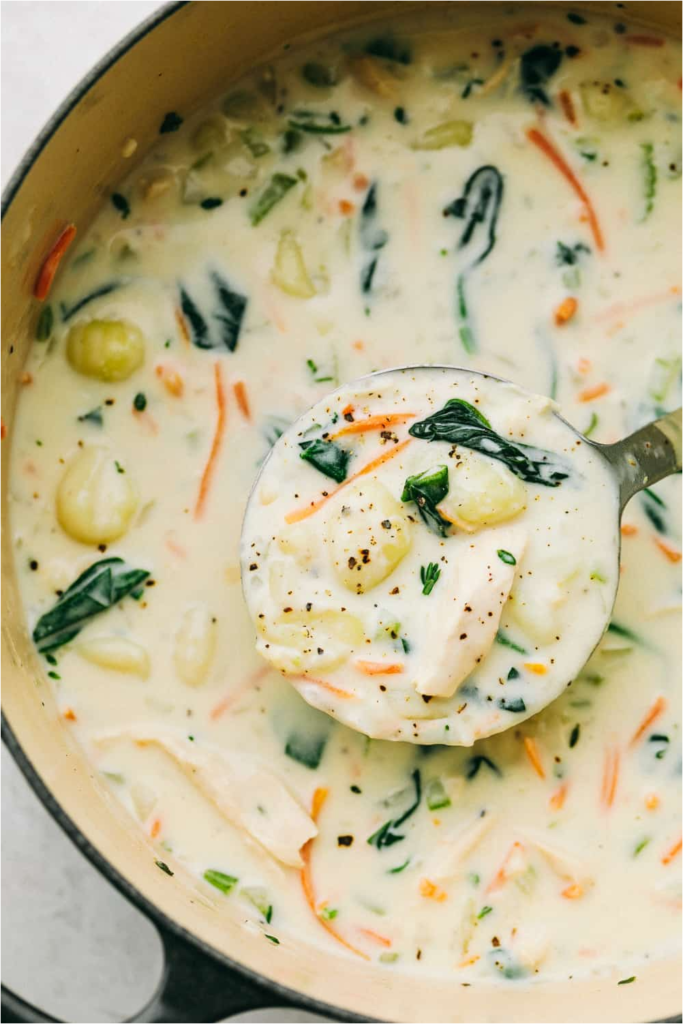
Chicken: The Tender Skeleton
Chicken isn’t the main ingredient here, but it’s an indispensable skeleton. Without it, this soup is just a pot of creamy gnocchi—delicious, but incomplete. With it, the soup becomes substantial, provides protein, and gives you that satisfying feeling of “I’ve had a meal.”
Use boneless chicken breast. Not chicken thigh—although chicken thigh is juicier and more resistant to overcooking, in this soup that only needs to be cooked for twenty minutes, chicken breast will retain its tenderness, while the advantages of chicken thigh won’t be fully utilized. One pound of chicken breast, about two pieces, should be boiled first, then shredded or diced.
Boiling the chicken is simple: place the chicken breast in a small saucepan, add water to cover the meat, a pinch of salt, bring to a boil over high heat, then reduce to a simmer and cook for 15 to 20 minutes, until the internal temperature reaches 165 degrees Fahrenheit. Remove, let cool, and then shred the meat along the grain using two forks. The shredding process is satisfying—you’ll see the fibers separate and the juices seep out from the breaks. The shredded chicken should be fluffy, textured, and each strand retains its individual shape.
If you’re in a hurry, you can use ready-made roasted chicken. Supermarket rotisserie chicken is a lifesaver—it’s already roasted, seasoned, and easy to shred. Shred one pound of roasted chicken and add it directly to the broth. It will have a richer, more complex flavor than boiled chicken, with a hint of smokiness and spices. The downside is that you can’t control the saltiness. If the roast chicken is salty, your soup will become salty as well. Therefore, when using roast chicken, be careful with the final seasoning; taste before adding salt.
Trinity and Garlic: The Foundation of Aroma
The base of this soup is classic mirepoix—onions, carrots, and celery. Not the delicate kind that requires finely dicing, but rather coarse, irregular, bite-sized chunks. Since it will all be cooked until tender anyway, shape doesn’t matter; flavor is.
One medium-sized onion, coarsely chopped. As the onion is sautéed in butter, it transforms from pungent to mild, from translucent to golden, from irritating to sweet. This transformation takes five to seven minutes, depending on your heat and patience. Don’t rush it; let the onion sit quietly in the pot, stirring occasionally, until caramelized spots begin to appear around its edges.
Two celery stalks, chopped to pieces about the same size as the onions. Celery provides that fresh, slightly bitter, invigorating green aroma. Its fibers soften after stewing, yet retain a slight crunch, contrasting with the soft, chewy texture of the dough pieces.
One cup of carrots, shredded or sliced thinly. Carrots provide sweetness and color. Not the cloying, candy-like sweetness, but a plant-based, fresh, slightly earthy sweetness. Shreds are better than cubes because they curl up as they soften in the soup, thinning at the edges and thickening in the center, creating an interesting textural variation. Shreds also cook more easily, reaching a tender consistency in a shorter time.
Four cloves of garlic, minced. Garlic isn’t the main ingredient here, but it’s the indescribable element that completes the other flavors. Without garlic, the soup lacks a base of umami, a supporting force that allows the flavors to “stand up.” When garlic and mirepoix are sautéed in butter, an undeniable, warm, slightly spicy aroma fills the kitchen. At this point, your kitchen begins to exude the atmosphere of an Italian restaurant.
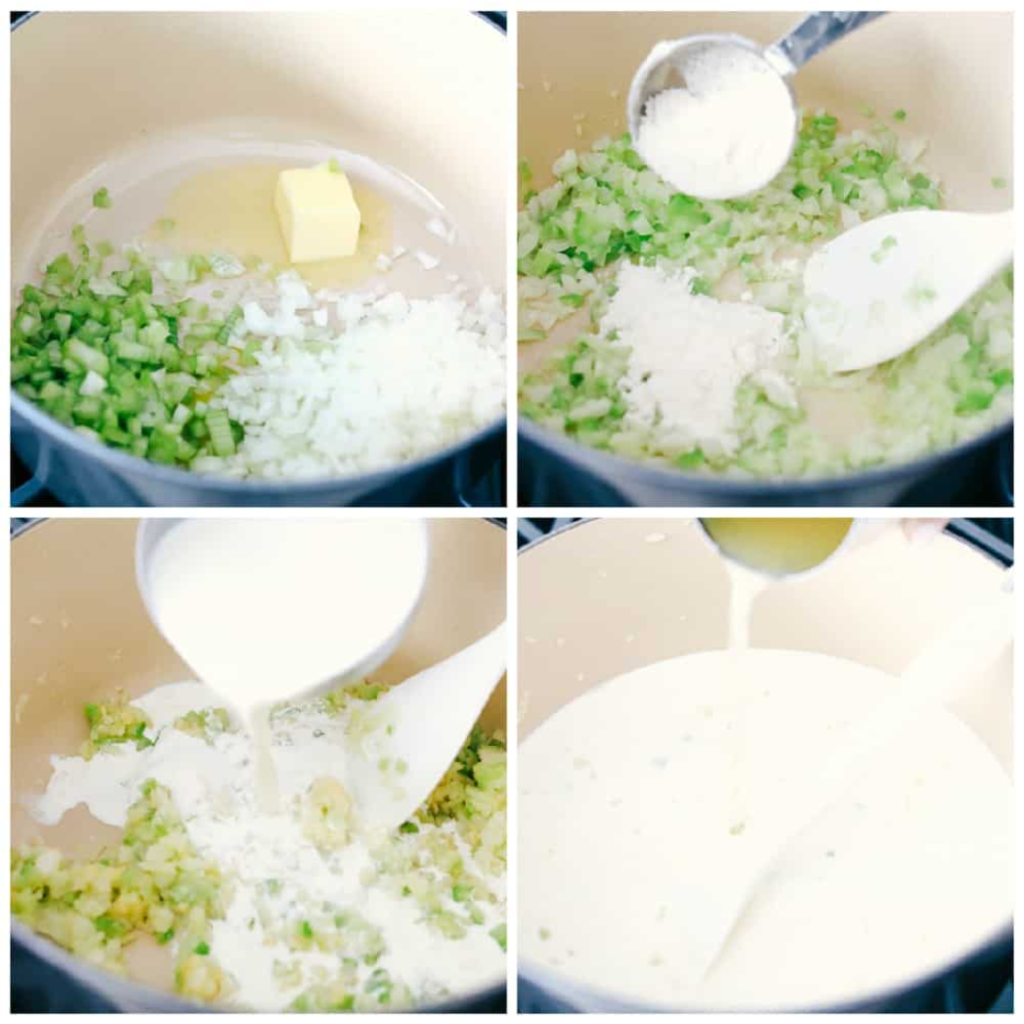
White Sauce: The Transformation from Clear Broth to Thick Soup
The soul-stirring moment of this soup occurs when butter and flour meet—when you turn a clear broth into a thick soup.
Melt four tablespoons of butter in a large saucepan over medium heat. The butter here isn’t just for aroma; it’s the base of the white sauce. Once the butter has melted, add mirepoix and garlic, and sauté for five to seven minutes, until the vegetables are soft, the onions are translucent, and the kitchen is filled with that irresistible aroma. Then, add a quarter cup of flour and stir until combined, allowing the flour to simmer in the butter for one to two minutes. This minute is crucial—it allows the raw taste of the flour to dissipate, leaving a subtle, nutty, caramelized aroma.
Then, slowly add the chicken broth—four cups, about one liter. Don’t pour it all in at once—stir constantly to prevent lumps from forming. Pouring cold chicken broth into a hot flour paste will cause the sauce to clump together, forming frustrating lumps. Therefore, the chicken broth is best served warm—you can microwave it for a minute beforehand, or pour it directly from the pot. While pouring, stir constantly with a whisk or wooden spoon until the liquid and flour are fully combined, resulting in a thick, shiny, lump-free liquid.
At this point, the soup is still clear—pale yellow in color, thin in texture, and mild in flavor. But it already has a framework—the roux from the flour and butter will give the soup its thick texture, and the chicken broth will give it depth of umami. Now, it’s time to make it rich, creamy, and irresistible.
Cream and Parmesan: The Perfect Finishing Touch
The cream is the turning point in this soup. Before adding the cream, it’s just a thick soup—delicious, but not particularly special. After adding the cream, everything changes. The soup becomes thick, silky, and creamy, but without the greasiness of cream.
Two half-and-half cups, or one and a half cups of whole milk and half a cup of heavy cream. Half-and-half is ideal—it has a higher fat content than whole milk but less than heavy cream, giving the soup a velvety texture without making it too heavy. If you don’t have half-and-half, you can use whole milk, but the effect will be slightly less—the soup will be thinner and lack that rich, satisfying texture.
Add the cream last—after the pasta is cooked, the chicken is added, and the soup has been removed from the heat or is simmering. Do not pour the cream into the boiling soup—the high temperature will cause the cream to separate, resulting in a layer of oil floating on the surface of the soup. While the flavor will remain, the appearance will be less appealing. The correct method is to turn the heat to the lowest setting, or turn it off altogether, and then slowly pour in the cream, stirring constantly. The cream will blend into the soup, changing its color from pale yellow to milky white, its texture from thick to silky, and its flavor from delicate to full-bodied.
Parmesan cheese is the final touch. A quarter cup, grated, is added after turning off the heat. The umami and savory flavor of the Parmesan will add complexity and depth to the soup, making it taste more like the kind you’d get in a restaurant. Don’t use pre-ground Parmesan in a plastic bag—those usually have added cellulose to prevent clumping and don’t dissolve well. Buy a whole Parmesan and grate it yourself. Grated Parmesan will melt quickly in the hot soup, blending with the cream to create an irresistible, rich flavor that will make you want another bowl.
Spinach: The Final Touch of Green

Spinach is the finishing touch to this soup. Two cups of tender spinach are added directly to the pot after the soup is removed from the heat, before serving. Do not cook—the residual heat will partially cook the spinach, preserving its crisp, grassy texture. Cooked spinach will shrink, soften, and lose its color, becoming a dark green, unappetizing mushy mess. Half-cooked spinach is vibrant green, retains its shape, and offers a crisp texture with every bite.
Spinach serves more than just color. It provides a refreshing, slightly bitter, and invigorating flavor that balances the richness of the cream and Parmesan. Moreover, the spinach is tender and smooth, contrasting with the fluffiness of the dumplings and the fibrous texture of the chicken. Every sip of soup should contain a few pieces of spinach, like a small, unexpected twist.
If you don’t like spinach, you can substitute kale or Swiss chard. However, kale needs to be cooked longer, otherwise it will be too tough; the stems of Swiss chard need to be removed, otherwise they will be too coarse. Spinach is the simplest and most forgiving option—it requires no pre-treatment; simply toss it into the pot at the end and let it be gently blanched by the residual heat.
Thyme: The Unexpected Herb
Thyme is the secret weapon of this soup. One tablespoon of fresh thyme leaves, or one teaspoon of dried thyme. Thyme has a woody, slightly lemony flavor reminiscent of sun-drenched Mediterranean hillsides. It’s not an overpowering herb, but rather a quiet, understated element that completes the soup’s flavor.
Fresh thyme is better than dried—its aroma is fresher, brighter, and more vibrant. But if you only have dried thyme, that’s perfectly fine too. Add thyme along with the chicken broth, allowing it to slowly release its aroma and blend with the other ingredients during cooking. Don’t add it last—dried thyme needs time to “open up,” and fresh thyme needs time to “release.”
Thyme’s role here is to make the soup more mature, more complex, and with a touch of unexpected twist. A soup without thyme is mild, rounded, and comforting; a soup with thyme is mild, rounded, but with a sharp edge—like a good-natured but opinionated friend. This subtle difference is the difference between a homemade soup and a restaurant soup.
Assembly and Seasoning: The Final Touch
Pour the cooked shredded chicken into the broth and stir well with the cream and Parmesan. The chicken will absorb the richness of the cream, becoming moist, flavorful, and transforming from “delicious meat” into “meat you’ll want to lick the plate clean.”
Then taste it. Add salt, add black pepper, until you feel “just right.” The amount of seasoning depends on how salty your chicken broth is, how strong your Parmesan is, and how strong your palate is. Don’t add too much at once—you can add it gradually by tasting, but it’s difficult to remove excess salt. Be conservative, take your time, until that sip of soup feels perfect.
If you like, add a pinch of ground nutmeg. Not the kind that reminds you of Christmas cake, but the kind used in very small amounts, almost imperceptible, but that adds a rounder, warmer flavor to the cream. A quarter teaspoon is enough; don’t add too much. Its purpose is to enhance the texture of the cream, making the soup more complex and nuanced. This is a classic Italian technique—adding a pinch of nutmeg to cream sauce transforms the flavor from “good” to “memorable.”
Pour it into a bowl. Not a shallow soup plate, but a deep bowl you can hold in your hands. The soup should be milky white, warm, and slightly shimmering under the light. The dumplings should be scattered like pearls, the shredded chicken like clouds, and the spinach like green sails.
When eating
Use a spoon. Starting from the rim of the bowl, scoop up a spoonful of soup, making sure the spoon contains dumplings, chicken, and spinach. Put it in your mouth, first feeling the temperature with your tongue—it should be warm, but not scalding, just right for a comfortable swallow.
The soup’s flavor unfolds in distinct layers: first, the smoothness and buttery aroma of cream; then the richness and umami of chicken broth; next, the woody notes of thyme rise from the nose; and finally, the savory umami of Parmesan and the warmth of nutmeg linger on the tongue. If you use roast chicken, the smoky and spiced flavors emerge in the middle, like a small, delightful surprise.
Around the middle, the ingredients begin to meld. The gnocchi absorb more broth, becoming softer and fuller; the shredded chicken and cream intertwine, creating a new, somewhere in between; the spinach infuses the soup, making it more complex and blended. Every spoonful at this point is different from the first—more integrated, richer, and more satisfying.
The last few bites are usually the best. The bottom of the bowl holds the essence of all the flavors—cream, chicken broth, Parmesan, thyme, and the starch of the gnocchi. Scrape them up with a spoon, and it’s a concentrated, unreserved, and blindingly delicious experience. You’ll want to lick the bowl clean, but restrain yourself—leave a little for the anticipation of the next meal.
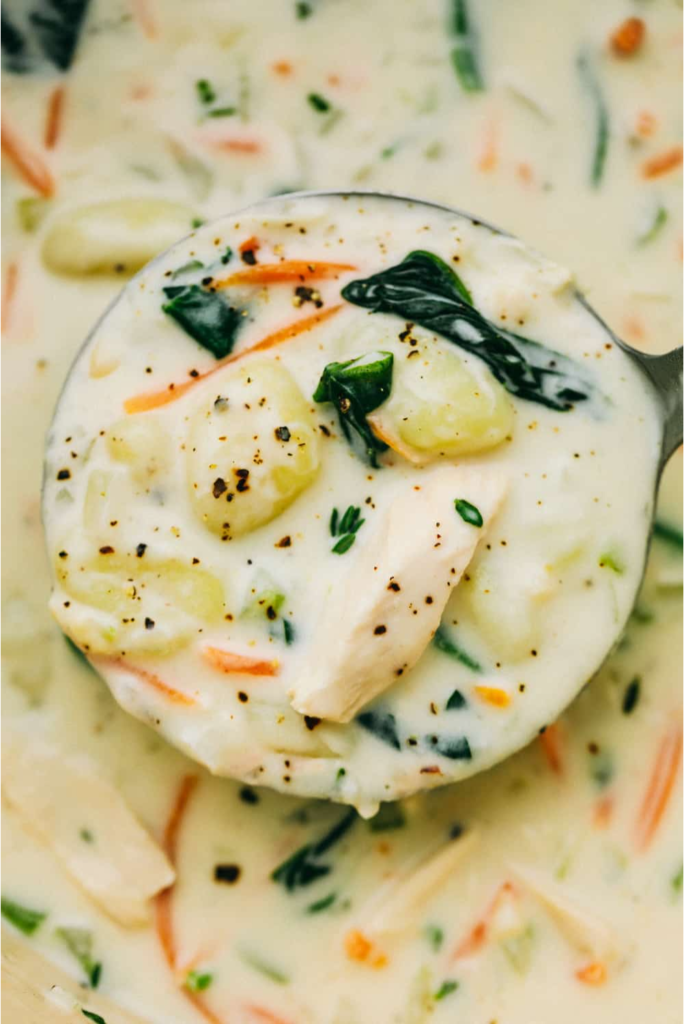
I make this soup in winter. Not because it’s winter-only—you can actually make it year-round—but because winter evenings are dark early, the wind sneaks in through the window cracks, and I don’t want to stand in the kitchen for too long. This soup only takes forty minutes, twenty of which are spent simmering in the pot, and you only need to stand by the stove for about twenty minutes.
When you sit at the table with your bowl, spooning a ladleful of milky white soup, a fluffy dumpling, and a sliver of tender chicken, with the wind still blowing outside, you’ll remember that afternoon when you decided to recreate a restaurant soup at home. Back then, you thought it was just imitation. Now you know it’s something better—it’s creation, an understanding of flavor, the simplest and most profound magic in the kitchen.
And it’s truly delicious. So delicious that you’ll want to make it again and again. It’s so delicious that on a chilly afternoon, you might suddenly crave its flavor, then walk into the kitchen and start peeling potatoes—or open a vacuum-packed bag of dough.
Preparation Time: Approx. 10 minutes
Cooking Time: Approx. 30 minutes
Total Time: Approx. 40 minutes
Servings: 4-6 people
Difficulty: Can be made with any pot
What You’ll Need:
Soup:
- 4 tablespoons unsalted butter
- 1 tablespoon olive oil
- 1 medium yellow onion (roughly chopped)
- 1 cup carrot (shredded or thinly sliced)
- 1 cup celery (roughly chopped)
- 4 cloves garlic (minced)
- 1/4 cup all-purpose flour
- 4 cups low-sodium chicken broth (approx. 1 liter)
- 1 pound chicken breast (approx. 450g, cooked and shredded; or freshly roasted and shredded)
- 1 pound gnocchi (approx. 450g, vacuum-packed or fresh)
- half-and-half 2 cups (or 1.5 cups whole milk plus 1/2 cup heavy cream)
- 2 cups fresh spinach (roughly chopped)
- 1 tablespoon fresh thyme (or 1 teaspoon dried thyme)
- 1/4 cup Parmesan cheese (shredded)
- 1/4 teaspoon ground nutmeg (optional)
- Sea salt to taste
- Black pepper to taste
Instructions Summary:
- Cook the chicken: Place chicken breast in a small saucepan, cover with water, add a pinch of salt, bring to a boil over high heat, then reduce to low heat and simmer for 15-20 minutes until the internal temperature reaches 165°F. Remove and let cool, then shred with two forks. If using roasted chicken, shred directly.
- Sauté the vegetables: Melt butter and olive oil in a large saucepan over medium heat. Add onions, carrots, and celery, and sauté for 5-7 minutes, until the onions are translucent and the vegetables are softened. Add minced garlic and sauté for 1 minute until fragrant.
- Make the white sauce: Sprinkle in flour, stir well, and sauté for 1-2 minutes until the raw flour taste disappears. Slowly pour in warm chicken broth, stirring constantly to prevent lumps. Add thyme and stir well.
- Cook the pasta: Once the broth boils, add the pasta and cook for 3-5 minutes until they float to the surface. Do not overcook.
- Add chicken and cream: Add shredded chicken and stir well. Reduce heat to low or turn off the heat, and slowly pour in the half-and-half sauce, stirring constantly.
- Final seasoning: Add Parmesan cheese and nutmeg powder (if using), and stir until the cheese melts. Taste and adjust seasoning with salt and black pepper.
- Add spinach: Turn off the heat and add the spinach directly to the broth, blanching it until partially cooked using the residual heat.
- Garnish: Transfer to a deep bowl and garnish with a sprinkle of Parmesan cheese and black pepper if desired. 9. Pick up the bowl, find a comfortable place to sit, hold the bowl with both hands, and slowly sip your soup. Don’t rush; this soup is worth savoring.
Tips:
- Add the dough pieces after the soup boils and cook for 3-5 minutes. Overcooking will cause them to become mushy.
- Add the butter over low heat or after turning off the heat. High temperatures will cause the butter to separate into oil.
- If using roasted chicken, be careful with the amount of salt added at the end, as the chicken is already salty.
- Leftovers can be refrigerated for 3-4 days or frozen for up to 1 month. When freezing, it’s recommended to omit the spinach and add it just before eating.
- For a richer flavor, add two bay leaves when stir-frying vegetables; remove and discard them after cooking.