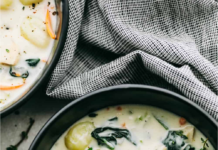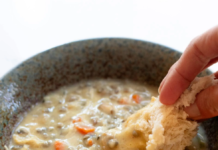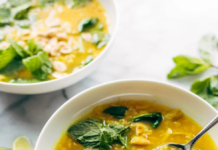
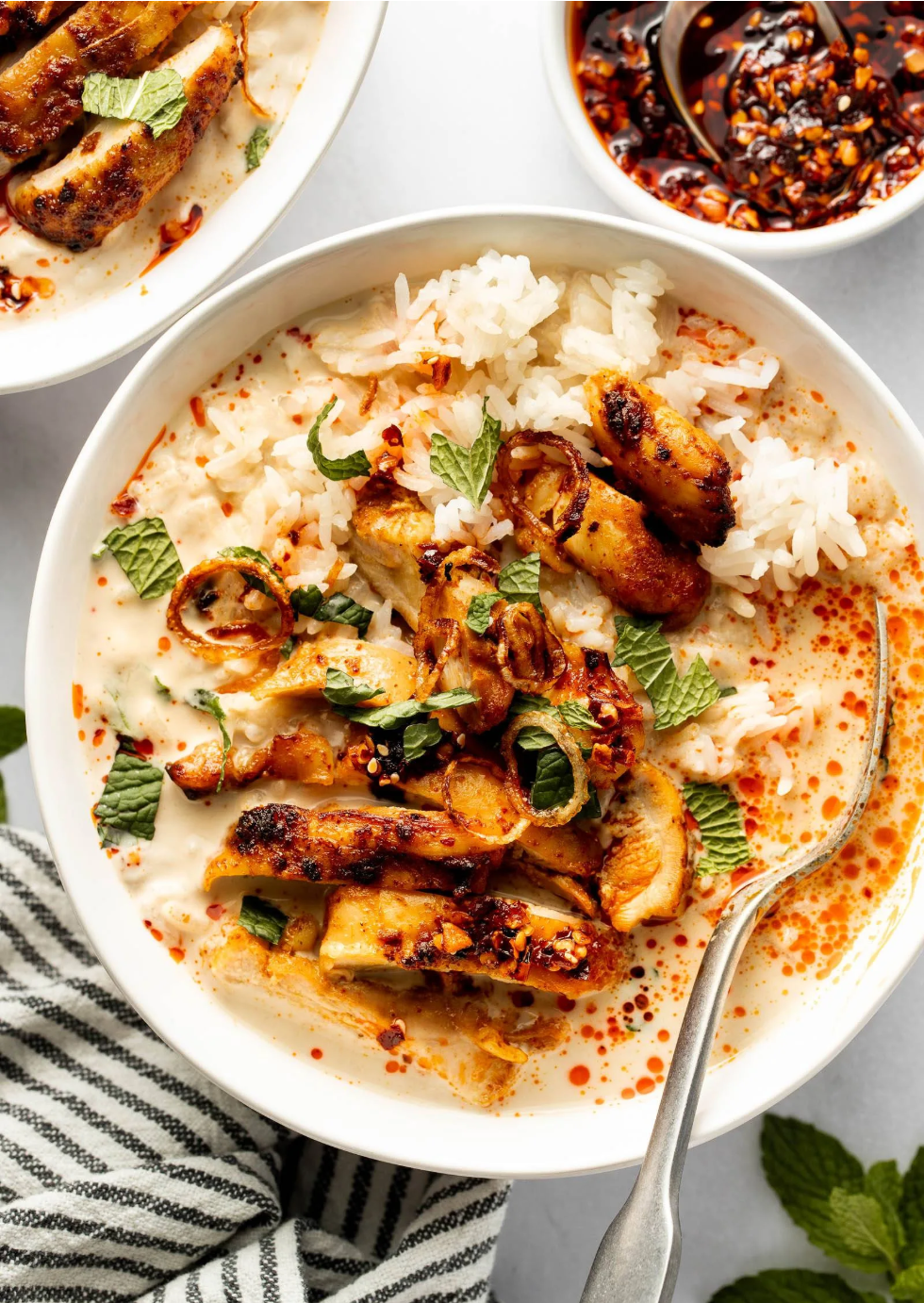
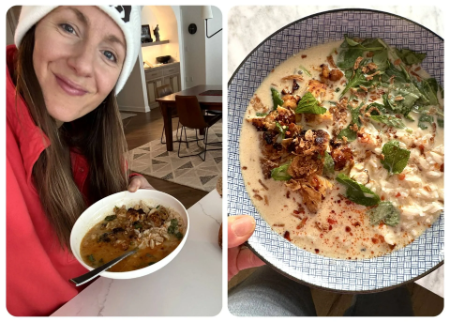
Some foods are messengers of the season. They don’t just fill you up; they tell you: winter is here, it’s time to slow down, time to warm your hands by the bowl. This lemongrass broth bowl is such a food—not the kind of fast food you wolf down, but the kind of dish you savor spoonful by spoonful, basking in the steaming warmth.
Its flavor reminds me of the streets of Southeast Asia—the humid air filled with the aroma of lemongrass, ginger, and coconut milk, something bubbling away in a pot at a roadside stall, you walk over, the owner glances up at you, and asks if you want it spicy. But this dish doesn’t require you to fly to Bangkok or Ho Chi Minh City; all you need is a pot, a few spices, and about thirty minutes. Then, your kitchen will be filled with that irresistible, warm, and slightly exotic aroma.
About Lemongrass: The Ambition of a Single Stalk
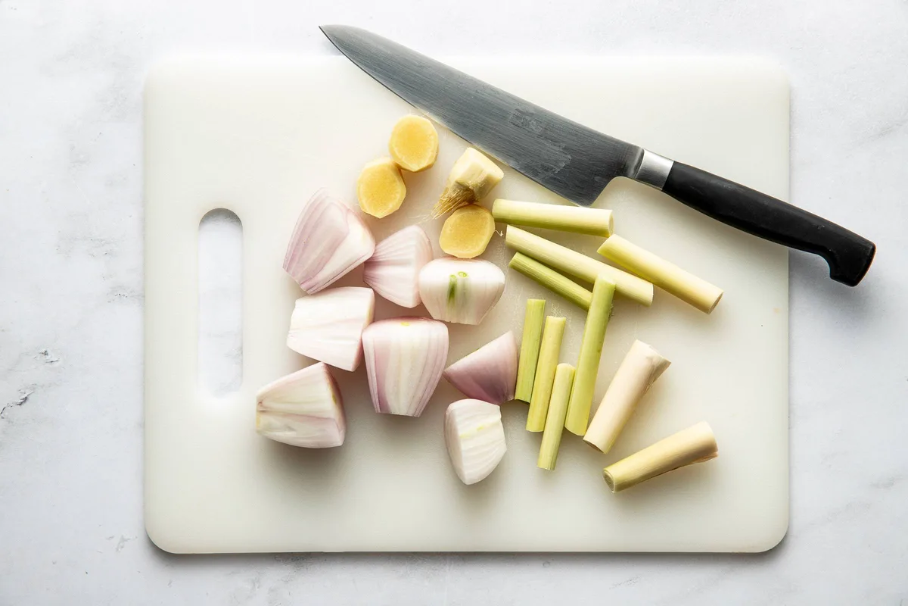
Lemongrass is the soul of this dish. Not the ornamental grass you might casually pick from your garden, but a tropical plant with a strong personality, a blend of lemon and ginger aromas. Its stems are hard, with a papery outer layer, yet conceal a concentrated essence within. To prepare lemongrass, you need to peel off the outer bark, cut off the top and root, and then gently flatten the stem with the back of a knife—not to chop it, but to break down the fibers and release the aroma during cooking.
The taste of lemongrass is difficult to describe. It’s not the sourness of lemon, nor the spiciness of ginger, but a refreshing, slightly woody, invigorating aroma somewhere in between. After simmering in the broth for twenty minutes, that aroma permeates every drop of liquid, filling the entire kitchen with a comforting scent. Once cooked, the lemongrass’s mission is complete—you can remove it and discard it, but its imprint is deeply etched into the broth, indelible.
One stalk of lemongrass is enough. Don’t be greedy and add too much, otherwise the soup will become too herbal, too sharp, losing its gentle balance. Lemongrass here is the background, the foundation, the unsung hero that makes other flavors shine.
Stock: A Gift of Time
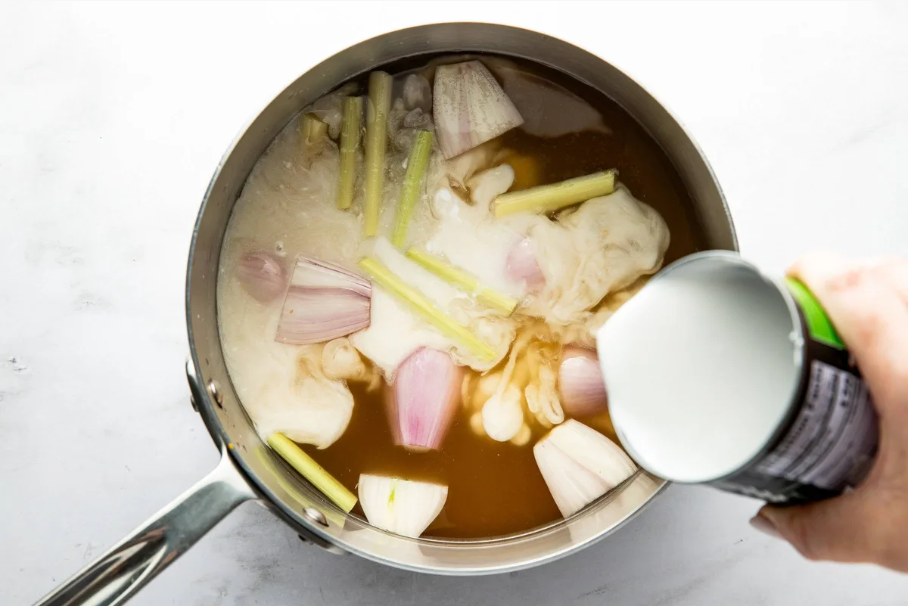
The method for making stock is so simple it’s almost perfunctory, yet its flavor is as complex as a novel. Three cups of chicken broth (or three cups of water plus a spoonful of concentrated chicken broth), a can of coconut milk, two shallots, a small piece of ginger, and a flattened stalk of lemongrass—all poured into a pot and simmered over low heat for twenty minutes. No stirring, no watching over it; simply cover and let time do the rest.
After twenty minutes, open the lid. You’ll see the soup’s color change from milky white to a pale creamy yellow—the color of the coconut milk and chicken broth blended together, warm and mellow. Use a slotted spoon to remove and discard the lemongrass, ginger, and shallots. They have done their job and don’t need to remain in the bowl. Then add three tablespoons of brown sugar, two tablespoons of reduced-sodium soy sauce, and one tablespoon of lime juice to the soup. The brown sugar brings a gentle sweetness, the soy sauce adds depth to the umami flavor, and the lime juice provides a refreshing, tangy kick.
At this point, the soup is ready to drink—not the kind that needs to be served with a main dish, but the kind you can hold the bowl, face the window, and sip slowly. Its flavor is layered: first, the smoothness and creaminess of coconut milk, then the fresh spiciness of lemongrass and ginger, followed by the sweetness of brown sugar and the saltiness of soy sauce mingling on the tongue, and finally, the tartness of lime rising from deep in the throat, clearing away all the other flavors and preparing you for the next sip.
But this isn’t the end. This soup will be poured over rice and chicken, becoming a complete dish. Therefore, its flavor needs to be stronger than when drunk as a soup—strong enough that the rice absorbs enough flavor instead of becoming bland.
Yellow Curry Chicken: A Dance of Caramelized Brown Sugar and Spices
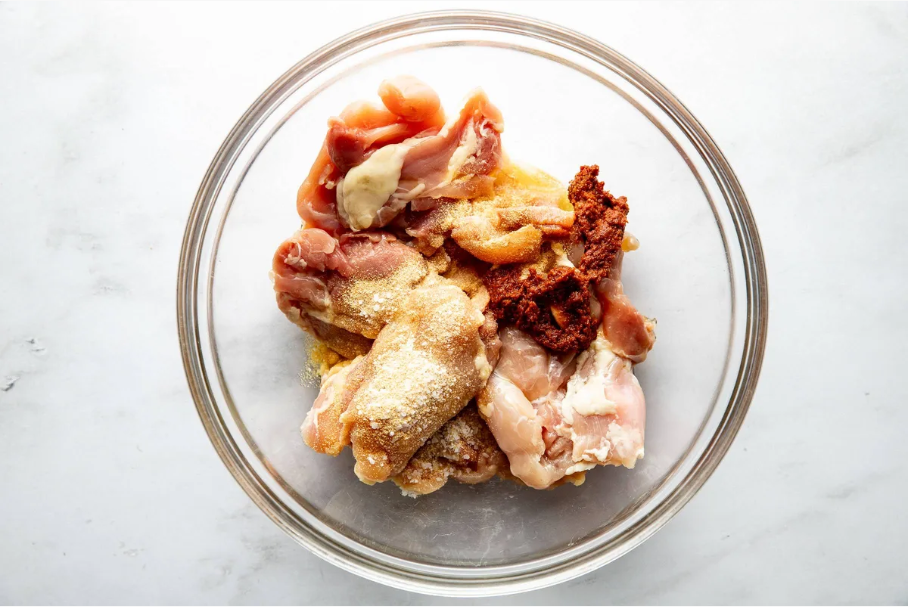
The chicken used is boneless chicken thigh meat. Not chicken breast—chicken breast dries out too easily, while thigh meat has fat and connective tissue, which keeps it juicy and tender at high temperatures. Cut the thigh meat into bite-sized pieces and toss with a spoonful of yellow curry paste, a teaspoon of garlic powder, half a teaspoon of salt, and a spoonful of olive oil. Yellow curry paste is another key to this dish—it’s typically made from a blend of spices including turmeric, coriander seeds, cumin, chili, lemongrass, and galangal, resulting in a golden color and a mild, complex flavor.
I usually air-fry the chicken—390 degrees Fahrenheit for twelve minutes. The hot air from the air fryer creates a thin, caramelized crust on the surface while the inside remains tender. You can also pan-fry it—on medium-high heat for three to four minutes per side, until golden brown and the inside reaches 165 degrees Fahrenheit. Don’t flip the chicken too frequently while pan-frying; allow it time to develop a caramelized crust. That crust isn’t just for decoration; it’s a concentrated flavor—hundreds of compounds produced by the Maillard reaction transform the chicken from “delicious” to “memorable.”
The cooked chicken should have a golden-brown surface from the yellow curry sauce, with slightly charred edges, and an aroma that’s a harmonious blend of spicy spices and the smoky flavor of the chicken. Cut it into smaller pieces, or keep it bite-sized—it’s up to your preference. I like to keep the pieces slightly larger so the chicken is visible in the bowl, rather than becoming a mushy mess in the broth.
Rice: The Gentle Base
Rice isn’t the main focus here, but it’s an indispensable base. Without it, this dish is just a pot of soup and a few pieces of meat. With it, everything becomes complete, substantial, and like a meal.
Use long-grain rice or jasmine rice. Not the sticky, mushy short-grain rice, but the kind that cooks with distinct grains and a subtle floral aroma. One cup rice, one and a half cups water, a pinch of salt, cook according to package directions. Once cooked, gently fluff the rice with a fork, ensuring each grain is separate and loose. This rice is delicious on its own, but in this bowl, its purpose is to absorb—to absorb the richness of the broth, the spices of the curry chicken, and all the essence that flows down from above.
The rice must be hot. Not lukewarm, but piping hot—the kind of hot that comes straight from the pot. Because when the broth is poured over, the hot rice will keep the broth warm, rather than letting the cold rice absorb the heat and become a lukewarm dish. Lukewarm food is the most disappointing—not hot enough, not cold enough, just some vague state in between.
Assembly: A World in a Bowl
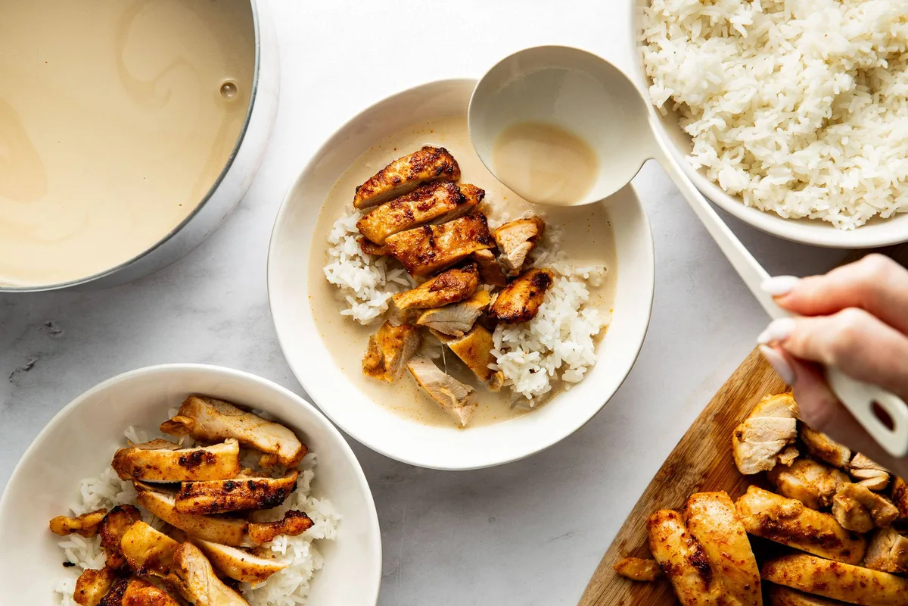
The assembly has an order, though not strictly strict, but logical. The bottom layer is hot rice, like a white canvas. Then comes the yellow curry chicken, generously layered, giving each piece its own place in the bowl. Next comes the broth—not pouring, but drizzling, like pouring sauce, starting from the center and working outwards in a circular motion, ensuring the broth evenly covers the rice and chicken.
The amount of broth is crucial. Too much will turn the bowl into a soupy mess, rotting the rice’s texture; too little will make the bowl dry and lose its soul as a “soup bowl.” The ideal amount is: broth covering the rice and chicken, but not too much liquid at the bottom. Each spoonful should leave the rice moist but not waterlogged; the chicken submerged in the broth but not floating.
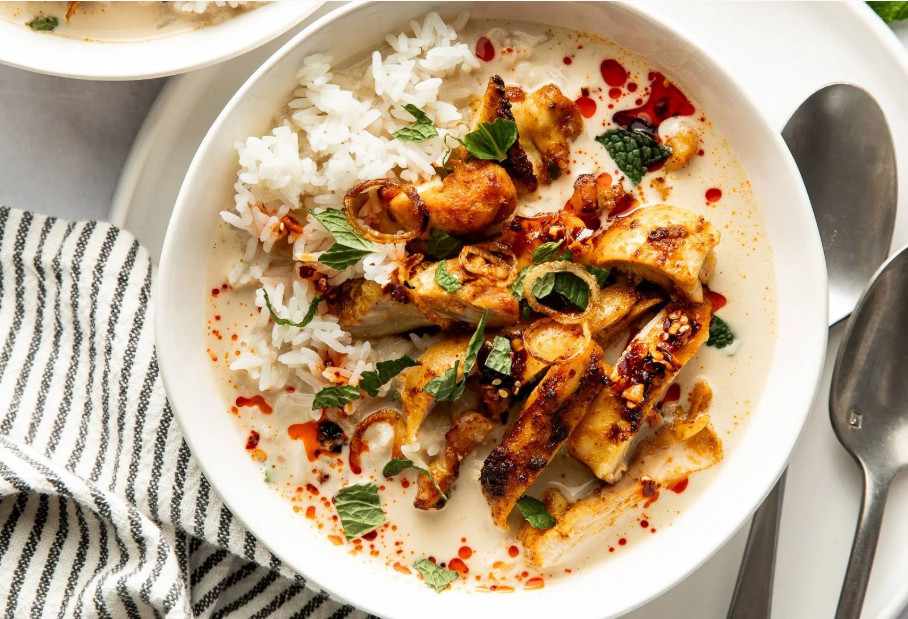
Then comes the garnish. Mint leaves—fresh, cool, and invigorating. Not cilantro, although that would work, but the coolness of mint is more suitable here. It’s like a gentle breeze, dispersing the richness of the curry and coconut milk, bringing a refreshing and unexpected twist to the whole bowl.
Then comes the chili oil—that bright red, mouthwatering chili oil sprinkled with sesame seeds and Sichuan peppercorns. Just a small spoonful is enough; don’t add too much. Its purpose is to provide a touch of spiciness and a hint of numbing sensation, transforming the overall flavor from “mild” to “more assertive.”
Finally, there’s the fried shallot—the crispy, golden-brown fried treat with a sweet onion aroma. You can make it yourself or buy it ready-made. Its purpose is to provide a contrast in texture—the soup is soft, the rice is soft, the chicken is soft, while the fried shallot is crisp, firm, and makes a slight “crunch” when you bite into it. It transforms the whole bowl from “a bowl of soup” into “a bowl of layered flavors.”
If you like, you can add a handful of tender spinach. Not cooked, but raw, sprinkled directly onto the hot soup, letting the residual heat partially cook it. The deep green of the spinach stands out vividly in the golden broth, and its slight bitterness and delicate flavor balance the richness of the curry and coconut milk.
When eating
Use a spoon. Not a fork, not chopsticks, but a spoon—the deep kind of soup spoon, big enough to scoop up rice, chicken, and broth all at once. Start with the rim of the bowl, scooping up a little rice, a piece of chicken, and enough broth. Put it in your mouth, first feeling the temperature with your tongue—it should be warm, but not scalding, just right for a comfortable swallow.
Then chew. The soft, sticky rice, the tender chicken, and the crispy fried shallots alternate in your mouth. The broth is rich, complex, slightly sweet, slightly sour, and slightly spicy. The coolness of mint rises from your nasal cavity, the spiciness of chili oil spreads across your tongue, and the sweet aroma of the fried shallots emerges at the end of the chew.
By the middle, the ingredients in the bowl begin to meld together. The broth seeps into the rice, saturating every grain with flavor; the curry chicken fat floats on the surface, forming a thin, golden film; the spinach, softened by the broth, transforms from crisp to slippery, intertwining with the rice. Each spoonful at this point is different from the first—more integrated, richer, and more satisfying.
The last few bites are usually the best. The bottom of the bowl holds the essence of all the flavors—broth, chicken fat, curry paste, soy sauce, lime juice, and chili oil. Scrape it up with a spoon—it’s a concentrated, unreserved, and irresistibly delicious experience. You’ll want to drink it all, but restrain yourself—save some for the next meal.
Regarding coconut milk, it must be full-fat. Low-fat coconut milk will make the soup thin and lose that rich, creamy texture. The fat in full-fat coconut milk gives the soup a velvety texture, making it smooth, full-bodied, and irresistible.
Regarding yellow curry paste, the brand is important. Some curry pastes are too spicy, some too sweet, and some too heavily seasoned. I recommend buying imported Thai brands like Maesri or Thai Kitchen. Maesri’s is more authentic and complex, but may be a bit spicy; Thai Kitchen is milder and better suited for those who can’t handle spice. If you can’t find yellow curry paste, you can use red curry paste, but the color will change from golden to orange-red, and it will be spicier.
Regarding air fryers, if you don’t have one, you can use an oven—400 degrees Fahrenheit for 15 to 20 minutes, until the chicken is golden brown. Alternatively, you can pan-fry it; the results are equally good. The advantage of an air fryer is that it gives the chicken a more even, crispy surface, but a pan-fry produces a more pronounced, smoky brown. Both methods have their merits, depending on your preferred texture.
Regarding brown sugar, don’t omit it. It’s not just for sweetness, but for balance. The spiciness of lemongrass and ginger, the richness of coconut milk, and the savory flavor of soy sauce all need a touch of sweetness to bind them together. Without brown sugar, the soup becomes sharp and thin; with brown sugar, it becomes rounded, full, and deep.
As you sit at the table, bowl in hand, spooning a ladleful of golden soup, a piece of caramelized chicken, and a few grains of rice soaked in flavor, the wind still blowing outside, you’ll remember that afternoon when you decided to put lemongrass and coconut milk in the same pot. Back then, you thought it was just an ordinary soup. Now you know it’s something better—it’s a warm ritual, a response to winter, the simplest and most profound magic in the kitchen.
And it’s truly delicious. So delicious that you’ll want to make it again and again. So delicious that on a chilly afternoon, you’ll suddenly remember its taste, walk into the kitchen, and start peeling lemongrass.
Preparation Time: Approx. 10 minutes
Cooking Time: Approx. 30 minutes
Total Time: Approx. 40 minutes
Servings: 3-4 people
Difficulty: Can be made with just a pot
Ingredients:
Lemongrass Broth:
- 2 shallots (peeled, roughly chopped)
- 1 small piece of ginger (about thumb-sized, peeled, roughly chopped)
- 1-2 lemongrass stalks (peeled, top and root removed, flattened with the back of a knife)
- 3 cups chicken broth (or 3 cups water plus 1 tablespoon concentrated chicken broth)
- 1 can full-fat coconut milk (approx. 400 ml)
- 3 tablespoons brown sugar
- 2 tablespoons low-sodium soy sauce (adjust to taste)
- 1 tablespoon lime juice
Yellow Curry Chicken:
- Boneless chicken thigh meat 1 pound (approx. 450g)
- 1 tablespoon yellow curry paste (Maesri or Thai Kitchen brand recommended)
- 1 teaspoon garlic powder
- 1/2 teaspoon salt
- 1 tablespoon olive oil
Assembly and Garnish:
- 1.5 cups long-grain or jasmine rice (cooked according to package directions)
- Fresh mint leaves, as needed (torn or whole)
- Chili oil, as needed (Chili Crisp recommended)
- Fried shallots, as needed (store-bought or homemade)
- 1 bunch baby spinach (optional)
Instructions Summary:
Cook Rice: Cook rice according to package instructions and keep warm.
Prepare Stock: In a saucepan, combine shallots, ginger, and lemongrass with chicken broth and coconut milk. Simmer over low heat for 20-30 minutes. Remove and discard the spice chunks, reserving the stock. Add brown sugar, soy sauce, and lime juice, stir well, and adjust seasoning to taste.
Pan-Fry Chicken: Cut chicken thigh meat into chunks and marinate with yellow curry paste, garlic powder, salt, and olive oil. Air-fry at 390°F for 12 minutes until golden brown on the outside and 165°F on the inside; or pan-fry for 3-4 minutes per side. Cut into bite-sized pieces.
Assemble the Bowl: In a large bowl, first place hot rice, then top with yellow curry chicken, and pour hot stock over it. Sprinkle with mint leaves, chili oil, and fried shallots. If using spinach, sprinkle directly over the hot soup to cook it with the residual heat.
Pick up the bowl, find a sunny spot or warm light, hold the bowl with both hands, and enjoy your meal. Don’t rush, this dish is worth your time to savor.
Tips: The stock can be prepared a day in advance and refrigerated. Reheating it the next day will allow the flavors to meld even better.
If you don’t have yellow curry paste, you can use red curry paste, but the color and spiciness will differ.
Chicken can also be substituted with chicken breast, but the texture will be slightly drier; be careful to control the cooking time.
Fried shallots can be homemade: Slice shallots thinly, deep-fry in low-temperature oil until golden brown and crispy, drain the oil, and sprinkle with a little salt.